What Is Vibe Coding? A Smarter Way to Build Software with AI (2026 Guide)
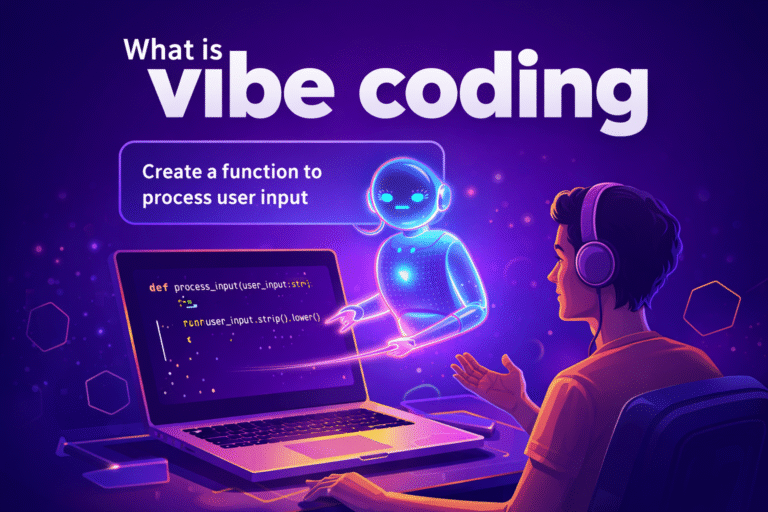
Table of Contents
Introduction
Coding has changed rapidly in the last few years. Earlier, learning to code meant memorizing syntax, watching long tutorials, and fixing errors alone. Today, developers work alongside AI tools, focus more on ideas, and write code through conversations instead of struggling with syntax.
In this shift, a new concept called vibe coding is gaining attention. Vibe coding is not a programming language or shortcut it’s a modern way of thinking about how code is written and learned in the age of AI. This blog explains what vibe coding is, why it’s becoming popular, and how beginners and developers can use it effectively without losing core programming skills.
What Is Vibe Coding?
Vibe coding is an approach to programming where developers focus on intent, logic, and creative flow, while AI tools assist with syntax, structure, and implementation details.
Instead of starting with code, vibe coding often starts with:
- an idea,
- a problem statement,
- or a natural language description.
The developer explains what they want to build, and AI tools help translate that intent into working code. The “vibe” refers to staying in a productive mental flow rather than breaking concentration over small syntax errors or boilerplate code.
Vibe coding does not remove the need to understand programming. Instead, it changes where human effort is spent from writing repetitive code to thinking about design, logic, and outcomes.
Why Traditional Coding Feels Slower Today
Traditional coding methods were built for a time when developers had no intelligent assistants. Every line had to be written manually, and every error had to be debugged alone.
Today, this approach often feels inefficient because:
- Developers spend excessive time on syntax instead of problem-solving
- Beginners feel overwhelmed before seeing results
- Learning curves feel steeper than necessary
- Creativity is interrupted by repetitive tasks
In a world where AI can generate boilerplate, explain errors, and suggest improvements, sticking to purely manual workflows can feel unnecessarily heavy.
This gap between old workflows and new tools is where vibe coding fits naturally.
Core Principles of Vibe Coding
Vibe coding works because it aligns with how modern developers think and work.
1. Intent Over Syntax
Instead of worrying about exact syntax, developers focus on clearly describing what they want to build. AI tools handle the translation into code.
2. Flow State Matters
Vibe coding aims to keep developers in a state of concentration. Fewer interruptions mean better momentum and faster learning.
3. AI as a Collaborator
AI is treated as a coding partner, not a replacement. Developers review, refine, and improve AI-generated code rather than blindly accepting it.
4. Faster Feedback Loops
Seeing working output quickly builds confidence and encourages experimentation, especially for beginners.
Vibe Coding vs Traditional Coding
Traditional coding emphasizes manual control and step-by-step construction. Vibe coding emphasizes direction and refinement.
In traditional workflows, progress is often slow but precise. In vibe coding, progress is faster, but requires judgment and understanding to guide AI correctly.
The key difference is not skill level, but where effort is applied. Traditional coding spends effort on writing. Vibe coding spends effort on thinking.
Who Should Try Vibe Coding?
Vibe coding is not limited to experts. It can benefit multiple types of learners and developers.
- Beginners can use vibe coding to overcome fear and see results early, making learning less intimidating.
- Students can use it to understand concepts by asking AI to explain code step by step.
- Professional developers can speed up prototyping and focus on architecture and logic.
- Career switchers can reduce friction while learning new technologies.
However, vibe coding works best when users stay curious and actively review what AI produces.
Is Vibe Coding Enough to Become a Skilled Developer?
Vibe coding is a powerful accelerator, but it is not a substitute for understanding fundamentals.
- Developers still need:
- logic building skills
- debugging ability
- understanding of data structures and algorithms
knowledge of how systems work
- Vibe coding helps you reach these stages faster by reducing friction, but mastery still requires learning, practice, and curiosity.
- Used correctly, vibe coding can make the journey smoother without lowering skill quality.
- Common Misunderstandings About Vibe Coding
- One common misconception is that vibe coding makes developers lazy. In reality, it demands better thinking and clearer communication.
- Another myth is that vibe coding replaces learning. It does not. It changes how learning happens by allowing learners to explore concepts interactively.
- Some fear that reliance on AI weakens skills. In practice, developers who actively review and refine AI output often develop stronger conceptual understanding.
The Future of Vibe Coding
Vibe coding reflects a broader shift in software development. As AI tools become more capable, developers will spend less time writing repetitive code and more time designing solutions.
This does not reduce the value of developers. Instead, it raises expectations around thinking, creativity, and judgment.
Vibe coding is not a trend to replace programming fundamentals. It is a new layer on top of them.
Conclusion:
Vibe coding reflects how modern software development is evolving alongside AI. Instead of spending most of the time memorizing syntax or fixing repetitive errors, developers can focus more on thinking, problem-solving, and building meaningful solutions. When used correctly, vibe coding makes learning and coding more accessible without replacing the need for core programming knowledge.
Vibe coding is already being adopted across modern AI-powered development platforms, where tools like Replit, GitHub Copilot, and other AI coding assistants help developers turn ideas into working code faster through conversation and experimentation.